![RRA_Logo_For_email.png]](https://knowledge.rudolphresearch.com/hs-fs/hubfs/RRA_Logo_For_email.png?height=50&name=RRA_Logo_For_email.png)
Vendor-Neutral Technical White Paper
Prepared from field observations and public technical sources
Summary:
Temperature control is one of the most critical variables in analytical measurement, yet it is also one of the most commonly misunderstood. Across laboratories and process environments, users often assume that a temperature problem must mean a failed board, a bad cooling/heating module, or defective hardware. In practice, field experience shows that this assumption is frequently wrong. Temperature instability is often created by the interaction of environmental load, control loop behavior, sensor error, thermal interfaces, and operating conditions rather than by a single failed component.
This paper explains why temperature control failures are commonly misdiagnosed, why intermittent behavior is especially misleading, and why instruments can appear to “work” while still producing temperature related measurement risk. It combines anonymized field examples derived from real service communications with public technical sources on temperature sensitive measurement, control systems, and thermoelectric cooling.
Introduction:
Analytical instruments are expected to produce precise, repeatable results under controlled conditions. Temperature sits at the center of that expectation because the properties being measured are often temperature dependent. Optical rotation depends on controlled temperature conditions, and refractive index is explicitly affected by temperature because temperature changes liquid density and therefore the way light travels through the sample. Public technical references discussing polarimetry, Density and refractometry note the need for precise temperature control for accurate measurements.
That dependency means temperature problems do not simply create a nuisance alarm, they directly affect whether a reported result can be trusted. The challenge is that temperature failures rarely present as a clean, permanent fault. Instead, they often show up as slow stabilization, overshoot, drift, intermittent inability to reach setpoint, or cases where a measurement is allowed at conditions that are not truly stable. Those are the kinds of failures that lead users to suspect hardware first, even though the deeper issue is usually in the larger thermal system.
Why Temperature Problems Are Commonly Misdiagnosed:
The temperature system is not just a heater or cooler. It is a closed-loop system made up of a sensor, a controller, an actuator, and the physical environment the system is trying to control. If any one of those elements is inaccurate, slow, overloaded, contaminated, or poorly coupled to the sample path, the instrument can appear to have a hardware failure even when all major components are technically functioning.
This is why temperature issues are so often misdiagnosed in the field. A board may be switching correctly, a thermoelectric element may still be responding to polarity change, and a sensor may still be returning a value, but the total system can still fail to hold the required condition. In other words, the instrument may not be broken in the simple parts replacement sense, but it may still be unable to produce a reliable temperature-controlled measurement. That distinction matters because swapping parts without understanding the system can increase service cost without solving the problem.
Environmental Conditions Are Often the Real First Cause:
Ambient temperature, airflow, humidity, and local heat load have a direct effect on thermal performance. Public calibration and metrology references consistently describe temperature as the most important environmental factor affecting instrument behavior and calibration integrity. Temperature changes alter both mechanical dimensions and electrical behavior, and unstable surroundings can introduce drift even when the internal control system is nominal
In field service, this shows up in very practical ways. One anonymized case involved a polarimeter that sometimes reached the requested setpoint of 20 °C and sometimes remained around 24–25 °C while still permitting measurement. The communication explicitly described the problem as random, noted that the instrument sometimes cooled within the allowed time and sometimes did not, and raised concern that the reported temperature did not meet the required condition for the result. The troubleshooting guidance in that same exchange started with basics such as room temperature, fan operation, clean filters, and correct cell seating before escalating to board-level troubleshooting. That is a classic example of why environment and thermal loading have to be considered before assuming an electronics fault.
A separate field conversation described conditions where cooling was slow and the ambient area itself was warm enough to be a concern. That pattern also supports the broader principle: when the instrument is already operating near the edge of its cooling capacity, room conditions can make a marginal system appear defective.
Thermoelectric Cooling Can Be Functioning and Still Be the Problem:
Many analytical instruments use thermoelectric cooling because it offers compact, precise, reversible control. But thermoelectric systems have limits. Their performance depends heavily on heat sinking, thermal contact, current control, and mechanical integrity. Public technical material on Peltier reliability explains that these modules often degrade through mechanical fracturing, solder-joint stress, increasing resistance, and reduced efficiency rather than through a simple on/off failure.
That distinction maps directly to field behavior. In one service discussion, a technician measured voltage changes at the relevant board connections and confirmed that the polarity switched as temperature demand changed. The message described visible wear on the cell assembly and much slower performance when cooling downward. The question asked whether the issue might be due to another component beyond the Peltier cells, even though the electrical response appeared to be changing correctly. That is exactly the kind of case where the system is not ‘dead,’ but its thermal capacity or transfer efficiency has degraded enough to create unstable control
Another real example referred to a repeated temperature-control failure and prior evidence of damage on a Peltier control board in a similar event. Even there, the discussion emphasized the need for diagnostic data rather than assuming the board was automatically at fault. The larger lesson is that thermoelectric systems can drift into poor performance long before a component presents as completely failed.
Control Loops Fail in Dynamic Conditions, Not Just Static Ones:
A temperature system that looks stable during idle warm-up is not necessarily stable during measurement. Closed-loop control has to deal with lag, overshoot, changing thermal load, and heat introduced by the sample path or measurement process itself. Public technical sources on Peltier-based control systems describe the need for multi-loop or carefully tuned control strategies to cope with dead time, polarity reversals, and thermal transients.
Field symptoms often expose this issue indirectly. One real world example described a system that sometimes maintained temperature for a period and sometimes failed unpredictably under the same nominal target. Another discussion centered on whether the issue was the display or actual control stability because measured voltages looked responsive while behavior in use remained questionable. These are strong reminders that a loop can appear electrically active yet still be poorly tuned or unable to manage the real thermal disturbance present during use.
This matters because many service decisions are made based on whether the instrument can reach setpoint once. Reaching setpoint once is not the same as controlling temperature under process load. A stable thermal system must both reach and hold the condition over time and under realistic operating conditions.
Sensor Problems Create False Temperature Stories:
A control system is only as good as the temperature it thinks it sees. Sensor drift, poor physical contact, bad connections, and electrical noise can all create a false picture of instability or, just as dangerously, a false picture of acceptable control. Public sources on calibration and ambient effects note that electronic components and sensors are temperature sensitive themselves, and that environmental conditions can distort readings if the system is not properly controlled or compensated.
A good field example comes from a service exchange involving an instrument that reported a probe-related issue straight out of the box. The troubleshooting centered on cable connection and LED status, and the issue was later resolved when a small magnet associated with the temperature probe was found to be missing from its correct position and located inside the measurement chamber. That is not a classic ‘bad board’ failure; it is an example of a sensor/probe system reporting a legitimate error because the mechanical sensing setup was not intact
Another field case involved fluctuating or implausible temperature readings documented in an internal troubleshooting file specifically for RTD temperature checks. The file states that sample temperature may read stable around 0.0 °C, over 100 °C, or fluctuate rapidly without stabilizing, and it explicitly identifies board-level soldering issues on one interface board as a common cause. The important point is that a bad temperature story on screen may originate in the measurement chain, not the heating/cooling chain.
Mechanical Fit, Sample Contact, and Cleanliness Matter More Than People Think:
Temperature control is never only electrical. Thermal performance depends on physical contact, alignment, cleanliness, airflow paths, and how the sample or cell sits in the controlled area. When those interfaces are compromised, the controller may react correctly to the wrong thermal reality.
One service message explicitly recommended confirming that the sample cell was laying flat in the trough against the heating/cooling plates as part of first-line troubleshooting for intermittent temperature-control failure. That is significant because it shows a real field assumption: before replacing boards, verify that heat is actually transferring into the sample path the way the instrument expects.
Another technical note for refractometer RTD troubleshooting points to soldering issues and board connections as common causes of erratic readings, while a separate service discussion described corrosion and visible wear contributing to slower cooling. These examples reinforce the idea that contamination, wear, contact quality, and assembly condition can all look like control failure from the outside.
The Most Dangerous Failure Is the One That Still Allows Measurement
Some of the most problematic thermal failures are not hard faults that stop operation. They are soft failures that permit measurement under conditions that are not truly within the intended control band. That creates risk because the user may walk away with a plausible-looking result and no obvious indication that the thermal condition was marginal.
While uncommon, the strongest field example is the intermittent temperature-stability email in which the instrument sometimes allowed a measurement to be taken while the actual temperature remained around 24–25 °C even though the setpoint was 20 °C. The message explicitly states that the result would be incorrect and that the actual temperature did not meet the setpoint regulation, creating a deviation concern
This is exactly why thermal issues should be treated as data-quality risks, not only service events. The instrument does not need to be completely nonfunctional for the failure to matter. In regulated or quality-sensitive settings, a temperature control problem that still produces a number can be more dangerous than a hard shutdown.
Practical Troubleshooting Principles
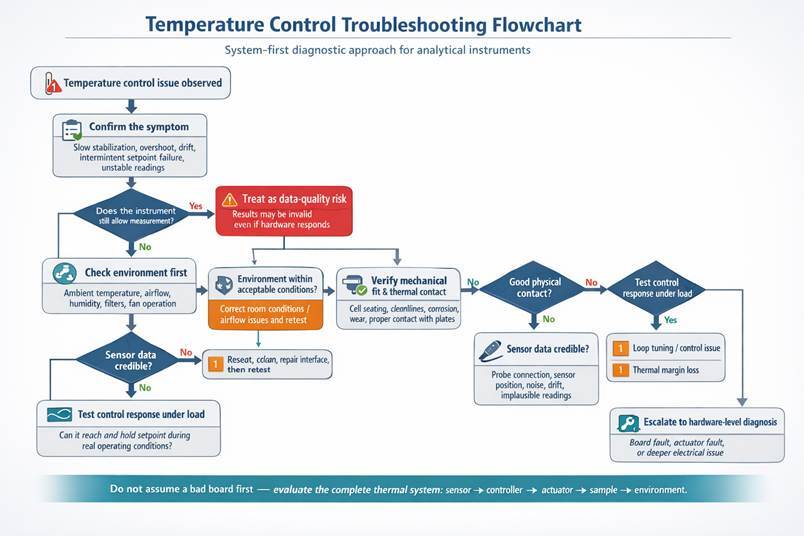
The field examples and public sources point to a consistent troubleshooting principle: start with the thermal system as a whole. That means checking ambient conditions, airflow, fans, filters, sample placement, physical contact, and contamination before assuming controller failure. It also means validating what temperature is actually being experienced at the control point rather than relying only on the displayed value. This principle is directly supported by the staged troubleshooting approach shown in the intermittent temperature example, which begins with room temperature, fan/filter condition, and sample-cell seating before escalating to deeper board-level checks.
Second, separate ‘can the hardware respond’ from ‘can the system control the process.’ Voltage reversal or heater activation alone does not prove the temperature loop is healthy. The example documenting voltage changes while cooling behavior remained questionable is a good example of this distinction.
Third, treat intermittent problems as evidence of margin loss rather than proof that nothing is wrong. Random-seeming temperature behavior is often what a weakening thermal system, degraded interface, or overloaded environment looks like before outright failure.
Conclusion:
Temperature control failures in analytical instruments are often attributed to bad hardware because hardware is the easiest thing to name and replace. But the evidence from real field cases and public technical sources points to a more difficult truth: many thermal failures are system failures, not single-part failures.
Environmental load, thermoelectric limits, loop tuning, sensor integrity, and mechanical fit all influence whether an instrument can truly reach and hold the condition required for a valid measurement. The service cost of ignoring that fact is unnecessary replacement and recurring problems. The data-quality cost is even higher: a system can appear operational while still producing results under the wrong thermal condition.
The most effective way to reduce temperature-control failures is to move from a parts-first mindset to a system-first mindset. In practice, that means understanding not only whether the hardware reacts, but whether the complete thermal path—sensor to controller to actuator to sample—actually performs as required under real operating conditions.